
.webp?width=832&height=592&name=customer-support%20(1).webp)



 Car Finance
 Cars & Gadgets
 Car Maintenance
 Tips & Advice
 News
News
 Road Trips
 Pop Culture
.webp?width=400&height=285&name=online-shoppers-with-dog%20(1).webp)
.jpg?width=500&height=356&name=Vintage%20car%20going%20to%20an%20old%20town-1%20(1).jpg)


Written by

Verified by

 What we cover


Whether you’re revising for your driving test, a new driver or someone who has years of experience behind the wheel, understanding road signs is important. Not knowing what a sign means can be frustrating at best, and at worst downright dangerous. And if you get the meaning of a sign wrong… well let’s not go down that road.
There are hundreds of different UK road signs, and some are easier to understand than others. To help you brush up on your sign-reading skills, we’ve put together a list of 10 fairly common road signs that might just catch you out.
Images: Crown copyright
1. No vehicles
This is one of the most easily misunderstood road signs out there. It’s not a mistake that the sign is completely blank, and it doesn’t mean it’s unfinished! In fact, it means no vehicles at all are allowed past that point. This includes bicycles as well as cars and motorcycles. The only exception is you can push a bicycle along the road while walking alongside it.
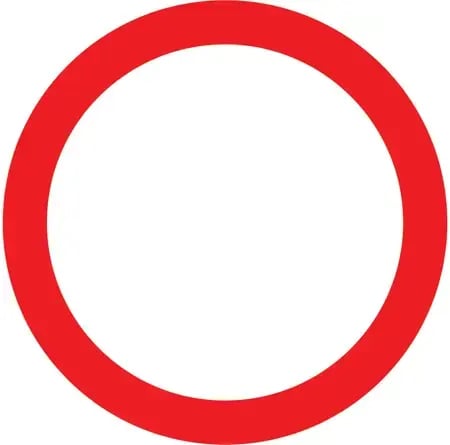
More common ‘no vehicles’ signs feature the same red circle, with a car or a car and motorbike in the middle.
2. Do not enter the motorway
This isn’t a picture of Stonehenge at night. It’s actually a sign that you’d see at the entrance to a motorway and it means ‘don’t enter’! Specifically, it means that all lanes are closed, so the number of vertical lines can vary according to how many lanes the road has.
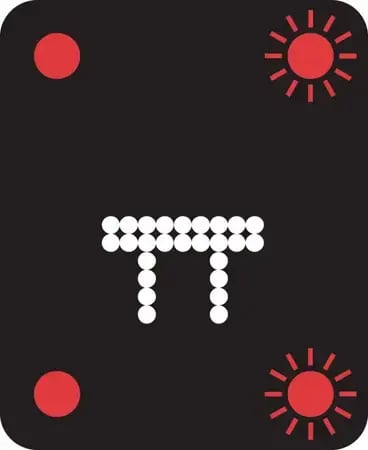
The red lights flash in pairs from side to side, making it clear that this is a ‘no-go’ situation.
3. Vehicles may pass either side to reach the same destination
This sign is often misunderstood, but it’s actually quite straightforward. It indicates that the road ahead splits both left and right, with both options going in the same direction. It’s often used on urban roads where there’s a traffic island that you can drive either side of.
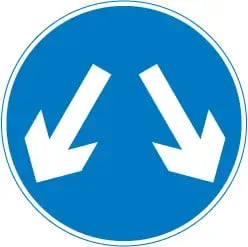
The official wording of ‘vehicles may pass either side to reach the same destination’ isn’t that helpful. It’s perhaps more useful to note that this sign essentially combines the ‘keep left’ and ‘keep right’ symbols, indicating that you can choose to do one or the other. But not both, obviously.
4. Slippery road
If you see this sign it’s not an invitation to test out your drifting skills, although you may end up driving like you’re in Drift Pro Max if you don’t slow down! It means there’s a higher-than-average chance of the road ahead being slippery, due to water, ice, mud or other conditions.
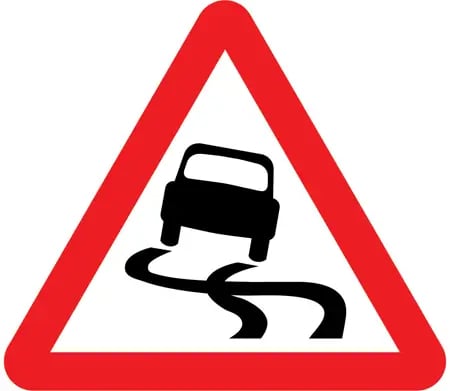
While many of these signs are in a fixed location, others might be temporary. In either case, you should make sure you’re driving at an appropriate speed and try to avoid turning sharply.
5. Ford ahead
Don’t worry, you don’t need a Ford vehicle to continue your journey. This common sign is found on roads where there’s a ford in the road ahead.
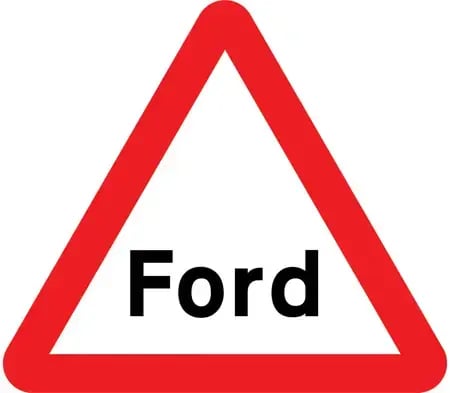
Most of the time these crossings are safe to drive through, but you need to be cautious if the water is fast-flowing, or if there has been a period of heavy rain. If you can’t tell how deep the water is or you’re in any doubt at all, turn around. It’s better to find another way to your destination and be a bit late than end up getting stuck or damaging your car.
6. Level crossing with a gate or barrier
This is a common road sign that should be easy to remember. And you really don’t want to get confused about this one, since ignoring it or misunderstanding it could put you in a lot of danger. Trains and cars don’t mix.
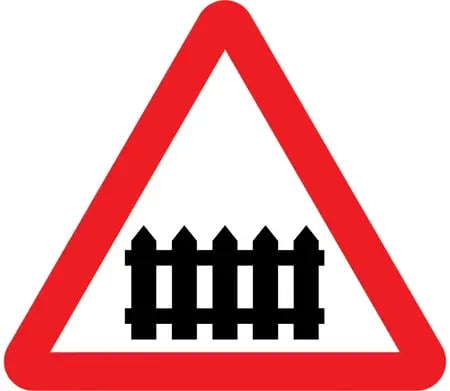
The other sign you might see before a level crossing is a red triangle with a black steam train in its centre. This indicates a level crossing without a gate or barrier, which can potentially be an even greater hazard.
7. T-Junction with priority over vehicles from the right
Another rare sign that’s easy to get wrong, this one means you have priority over vehicles on the right at an upcoming T-Junction.
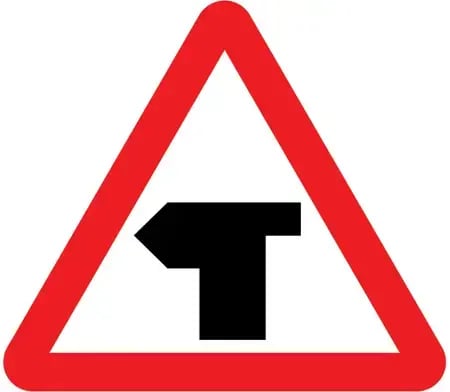
However, just because you have the right of way, that doesn’t mean you shouldn’t be cautious. Drivers approaching from the right-hand side might be equally as confused, and fail to slow down or stop for you at the junction.
8. Overhead electric cables
Don’t worry, you’re not at risk of getting struck by lightning in these zones. However, you may be at risk of getting electrocuted by overhead electric cables if your vehicle is too high.
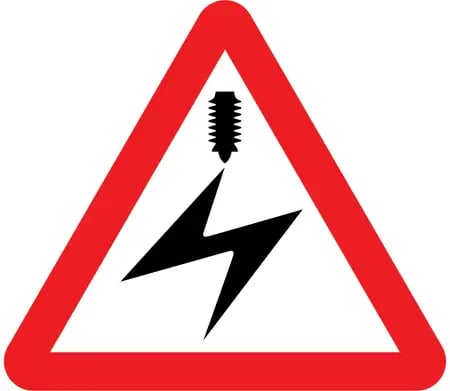
There should be a height restriction included on the sign, so you know how tall your vehicle needs to be to pass underneath safely.
9. Sharp bends ahead where traffic is diverted
This is a sign that you might encounter if you’re driving through, or approaching, a section of roadworks on a motorway. The full definition is: ‘Sharp bends ahead where traffic is diverted onto a temporary road for a short distance: the number of traffic lanes remains the same.”
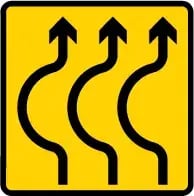
It’s a temporary sign indicating that although the road continues ahead, it will be diverted from its usual course so you should drive with caution.
10. End of minimum speed requirement
Believe it or not there are some roads where going too slowly can be a problem, usually in places like bridges or tunnels. In some of these locations you’ll see a minimum speed limit sign, which is a blue circle with the speed written in white. This indicates you should drive above that speed, unless it’s unsafe to do so.
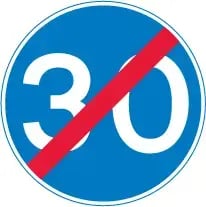
The sign you see here adds a red diagonal line through the speed, indicating that the minimum speed limit has ended so you can go back to driving as slowly as you like!
Images: Crown copyright

What does the total amount payable mean in car finance?
Total amount payable is the full amount you’ll pay for a car finance deal, including the amount you borrow, interest, and any...


Can you get car finance without a driving licence?
Yes, lenders like Carmoola offer car finance without a driving licence. Carmoola accepts applications from customers with a UK...

Getting car finance with a CCJ: what you need to know
You might still be able to get car finance with a CCJ (County Court Judgment), but you’re likely to face stricter checks and...